Crypto, the big picture
Best Cold Wallets in 2026: Ledger vs Trezor vs Tangem vs CoolWallet
To pick a cold wallet in 2026, decide three things first: whether you want to check transactions on the device's own screen, whether closed firmware is acceptable, and whether you back up with written words or with extra cards. The Ledger thefts traced back to tampered units in resale channels, leaked seed phrases and phishing; Ledger says its secure element was not broken.

Kelvin Wang · · 15 min read
Key points
- A cold wallet stops malware on your computer or phone. It can't stop a leaked recovery phrase, a malicious transaction you sign yourself, or a device tampered with before it reached you.
- The October 2026 Ledger implants were added in resale channels after the devices left the factory; Ledger says its secure element was not broken.
- Buy from the brand's store or an authorized reseller, never third-party or second-hand, and let the device generate your recovery phrase.
Each of the four brands bets on something different. Trezor’s firmware is open source. Ledger has five models to choose from. Tangem and CoolWallet Go are NFC cards with no screen that back each other up across several cards. CoolWallet Pro is a Bluetooth card with an e-paper screen.
Can a Ledger be hacked? In the implant cases of October 2026, devices were modified after they left the factory, inside resale channels. Ledger says its chip, operating system and servers were not compromised. What you control is where you buy and who generates your recovery phrase.
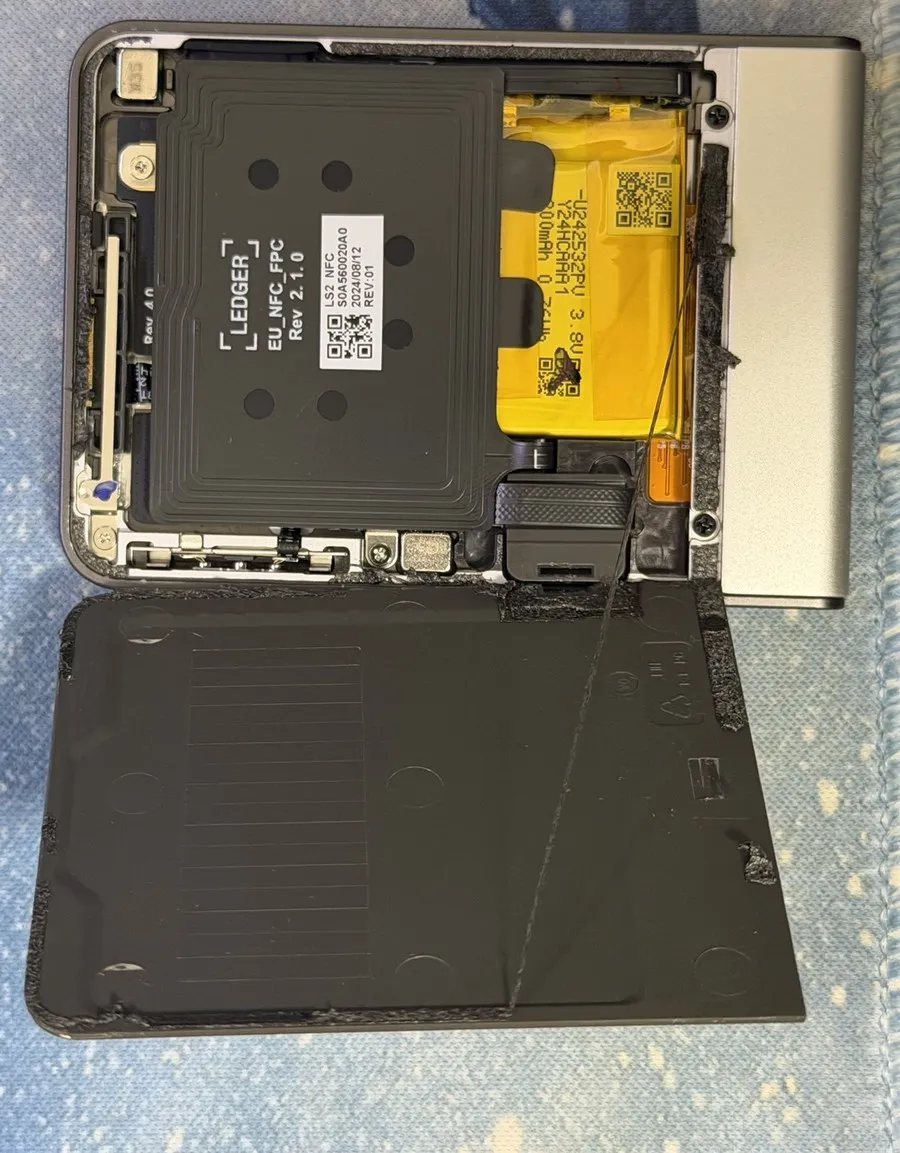
I use a Ledger Nano X and a Ledger Flex myself, and I made 3D teardowns of the implants for both: Nano X, Flex.
What a cold wallet protects against, and what it doesn’t
A cold wallet (hardware wallet) keeps your private keys on a chip that never goes online, and the keys stay on the device when it signs. If your computer or phone is infected, the attacker still can’t get the keys.
It does not protect you from these:
- A leaked recovery phrase. Anyone who has the words can restore the same keys in any wallet, on any device.
- Signing a malicious transaction yourself. In the Ledger Connect Kit incident of December 2023, attackers tampered with the library DApps use to talk to Ledger devices, so users signed transactions that sent their assets away. Losses exceeded US$600,000.
- A device that was tampered with before it reached you. The October 2026 implants were this kind, and Ledger’s authenticity check can’t see them.
- Whatever you keep on an exchange or hold through an ETF. Those layers are run by the exchange and the custodian, out of reach of your cold wallet. What went wrong at each of the five layers is in Are cold wallets safer? Hardware wallets, exchanges and ETFs: which layer failed.
2026 cold wallet comparison
| Model | Official price (US$) | Secure element | Open-source firmware | Screen and input | Backup | Chains |
|---|---|---|---|---|---|---|
| Ledger Nano S Plus | 69 [3] | CC EAL6+ | About 95% open; low-level secure element code not public [4] | 1.1" OLED, two buttons, USB | 24-word phrase; optional paid Ledger Recover subscription | 500+ directly in Ledger Wallet [1] |
| Ledger Nano X | 99 [3] | CC EAL5+ | Same | 1.1" OLED, two buttons, USB, Bluetooth | Same | Same |
| Ledger Nano Gen5 | 179 [3] | CC EAL6+ | Same | 2.8" E Ink touchscreen, USB, Bluetooth, NFC | Same | Same |
| Ledger Flex | 249 [3] | CC EAL6+ | Same | 2.8" E Ink touchscreen, USB, Bluetooth, NFC | Same | Same |
| Ledger Stax | 399 [3] | CC EAL6+ | Same | 3.7" curved E Ink touchscreen, USB, Bluetooth, NFC, wireless charging | Same | Same |
| Trezor Safe 3 | 59 [6] | EAL6+ | Open source [5] | 0.96" mono OLED, two buttons, USB-C | 12/20/24 words, or multi-share backup | Thousands of coins, with exceptions [5] |
| Trezor Safe 5 | 129 [7] | EAL6+ | Open source | 1.54" colour touchscreen, USB-C, no battery | 12/20/24 words, or multi-share backup | Same |
| Trezor Safe 7 | 249 [8] | TROPIC01 plus an EAL6+ chip | Open source | 2.5" colour touchscreen, USB-C, Bluetooth, wireless charging | 12/20/24 words, or multi-share backup | Same |
| Tangem (2 or 3 cards) | 54.90 / 69.90 [9] | Samsung, EAL6+ [11] | Card firmware closed and not updatable; app source published [11] | No screen on the card; tap to a phone over NFC | 2 or 3 cards hold the same wallet; seed phrase optional [10] | 90 blockchains, 14,100+ tokens [10] |
| CoolWallet Go | 69 [12] | CC EAL6+ [13] | Firmware not public [17] | No screen on the card; NFC; transactions confirmed only in the app | Primary card plus backup card, or a phrase generated in the app [15] | BTC, ETH, SOL, EVM chains and more [12] |
| CoolWallet Pro | 149 [12] | CC EAL6+ | Firmware not public [17] | E-paper screen, one button, Bluetooth, built-in battery, 0.8 mm card | Number sets shown on the card's screen, or 12/18/24 words from the app [14] | 30+ main chains, 12,000+ tokens [16] |
Prices checked 2026-11-07, before shipping, import duties and promotions. Ledger prices come from the product pages of Ledger's official store. Tangem's site showed a promotion banner on the check date; CryptoSlate found the 2-card set at 59.90 in September. Check each brand's checkout page before you buy.
Excludes shipping, import duty and promotions.
Source: ledger.com, trezor.io, tangem.com, coolwallet.io
How the four brands differ
Ledger
Ledger keeps the keys in a secure element, and on the Flex and Stax the secure element drives the screen directly. The firmware is not fully open source. Ledger says about 95% of its operating system and software is public, but the low-level code that talks to the secure element’s hardware is covered by an NDA with STMicroelectronics and can’t be published. The Nano S Plus and Nano X have a small screen and buttons; the Gen5, Flex and Stax have E Ink touchscreens and NFC.
Trezor
Trezor describes all three models as open source, and all three support multi-share backup: the backup is split into several shares, and a set number of them restores the wallet. The Safe 3 uses two buttons. The Safe 5 has a colour touchscreen and no battery, so it only has power while USB is plugged in. The Safe 7 adds Bluetooth and a battery, and next to its EAL6+ secure element it carries an auditable TROPIC01 chip. Each model also comes in a Bitcoin-only version.
Tangem
Tangem is an NFC card with no battery and no screen, used by tapping it to your phone. At setup, two or three cards store the same wallet, so you don’t have to write down a recovery phrase; you can generate one if you want. This has two costs. Once the backup is done you can’t add another card, and if every card is lost and you never generated a phrase, the funds are gone; Tangem can’t recover them. The card firmware is closed and can’t be updated. Kudelski audited it in 2018 and Riscure in 2023, but Riscure’s full report is not public.
With no screen on the card, you can only see the receiving address and transaction details on your phone. If the phone has been tampered with, what you check there may not be what the card actually signs.
CoolWallet
CoolWallet is made by CoolBitX, a Taiwanese team. The Pro is a credit-card-sized Bluetooth card, 0.8 mm thick, with an e-paper screen where you can check transaction details. When you create a wallet, the card can generate the recovery phrase and show it as sets of numbers on its screen, or the app can generate 12, 18 or 24 English words. The Go is a battery-free NFC card that relies entirely on the app for transaction confirmation, and it can be set up with a primary card plus a backup card. WalletScrutiny found no public firmware source and concluded the product is not verifiable.
Can a Ledger be hacked?
These four events come up whenever people ask. In none of them was Ledger’s secure element cracked. What failed was, in turn, the purchase channel, a customer database, the transactions users signed, and the design of one of Ledger’s own services.
- Harm done
- Warning or reduced service
-
July 2020
Ledger's e-commerce and marketing database leaks
A researcher reported it on July 14; the full data was posted on a forum on December 20 ([31]).
-
May 2023
Ledger announces Recover, and users push back
A paid, opt-in recovery-phrase backup service ([29]).
-
Harm done: December 14, 2023
Malicious code injected into Ledger Connect Kit
Losses exceeded US$600,000 ([32]).
-
Harm done: October 13, 2026
Ledger confirms implants in devices sold by reseller CryptoBilis
Ledger's Donjon team publishes a technical summary ([22]).
-
Warning or reduced service: October 15, 2026
Ledger tightens reseller rules
Sales paused in Southeast Asia and Hong Kong; returned units may never be resold ([24]).
-
Warning or reduced service: October 30, 2026
Trezor announces a reported implant in a Safe 5
Trezor did not have the device yet ([27]).
-
Harm done: November 12, 2026
Trezor confirms implants in three Safe 5s sold by CryptoBilis
Firmware 2.13.1, released the day before, blocks the capture; resellers cut by about 80% ([38]).
The implants: tampering after the factory
The tampered Ledgers had an extra board added to a genuine device. During wallet setup it read the recovery phrase off the screen and sent it out over a cellular link. On the Nano X the implant is soldered to the display SPI test pads; the Flex version adds an extension flex cable; the Stax version is a cellular board stacked on the main board. Ledger says there was no flaw in its chip, operating system or servers. But its authenticity check only confirms that the secure element is genuine, so while the original secure element is in place, it can’t detect an added implant.
The units with a known purchase channel came from CryptoBilis, a seller on Lazada, third-party sellers on Amazon Japan, a Japanese second-hand marketplace, MediaMarkt, Ozon, and shops in Singapore. As of November 3, none had been bought from the Ledger or Trezor website. The full list is in Should I replace my cold wallet? A checklist by where you bought it.
On October 13 Ledger asked resellers in Hong Kong, Indonesia, Singapore, Thailand, the Philippines, Vietnam and Malaysia to pause sales; Taiwan was not on the list. The same day, Trezor told some of its resellers that their authorization ends on January 1, 2027.
Trezor confirmed the Safe 5 implant on 11/12: three Safe 5s bought from CryptoBilis between 8/20 and 9/23 have an extra board stacked on the main board and an extra antenna behind the screen. It copies what is on screen, stores the wallet backup or passphrase when one appears, encrypts it and sends it over a mobile network, without changing the firmware or the secure element. Trezor released firmware 2.13.1 on 11/11 to block the capture and cut its reseller network by about 80%; no implant was found in devices from other resellers or in other Trezor models ([38]).
I turned the public teardown data into rotatable 3D models: Ledger Nano X, Ledger Flex, Ledger Stax and Trezor Safe 5, compared side by side in the Lab. The original research source for the Ledger implants’ part codes, versions and purchase channels is Karpelès Lab (Mark Karpelès): the Ledger implant OSINT report and the GitHub repository ledger_implant_osint. This article presents it in my own words; it is not affiliated with or endorsed by Karpelès Lab. The Safe 5 data comes from Trezor’s findings and comparison photo.
Ledger Recover (2023)
In May 2023 Ledger announced Recover. Subscribers pay to have their recovery phrase encrypted and split into three shards held by Ledger, Coincover and EscrowTech, and after an identity check it can be restored on the device. Critics said this contradicted Ledger’s long-standing line that keys never leave the device. Ledger replied that the service is opt-in and nothing changes for anyone who doesn’t turn it on. Recover went live in October 2023. The dispute was about trust: users can only take Ledger’s word for what the firmware is able to do.
The 2020 customer data leak and phishing
In July 2020 Ledger’s e-commerce and marketing database was breached, and in December the full data was made public: more than one million email addresses and about 272,000 records with names, postal addresses, phone numbers and products ordered. No private keys or recovery phrases were in it, but buyers were hit by heavy phishing afterwards. Ledger says it has shut down 216 phishing sites, and that devices and funds stay safe as long as you never share your 24 words with anyone. Official support never asks for your recovery phrase. Any page, app or caller asking you to enter your 24 words is a scam.
Which one fits you
- Mostly Bitcoin, and you want firmware you can inspect: Trezor. The Safe 3 is the cheapest, and Bitcoin-only versions exist.
- Many chains, mostly from your phone: Ledger Flex, Nano Gen5 or Nano X; the Trezor Safe 7 also has Bluetooth.
- Worried about miswriting or losing a recovery phrase: multi-card backup with Tangem or CoolWallet Go. Keep the cards in separate places, and accept that you can only check transactions on your phone.
- The thinness of a card, but with transaction details on the device: CoolWallet Pro.
- Large amounts: a model with a screen so you can check addresses on the device, plus Trezor’s multi-share backup or a passphrase.
I chose the Flex because the person who runs 區塊鏈日報, a Taiwanese crypto newsletter, recommended it, and the touch interface is easy to use.
Buying in Taiwan
- The brand’s own store. shop.ledger.com, trezor.io, tangem.com, coolwallet.io. Shipping to Taiwan and import duties show at checkout.
- Ledger’s authorized resellers. Ledger’s official list (November 7) names six authorized resellers in Taiwan: Syntrend (正成購物) at its Sanchuang store, momo, PChome, Csemart, “Shopee Ledger Authorized Store” on Shopee, and Fayaque. The Shopee shop is run by an authorized reseller: Ledger says a “Ledger Authorized Store” on marketplaces like Shopee is operated by an authorized reseller, not by Ledger itself. On momo and PChome, also check that the seller is the authorized one.
- Trezor’s authorized resellers. Buy from trezor.io or a shop on Trezor’s reseller list.
- CoolWallet’s authorized resellers. CoolWallet’s retailer page (November 7) lists seven resellers in Taiwan: CoinShang Technology (on Shopee), CoinWorld, 野口嘉 (on Shopee), COINSHA, 聚合電玩 (on Shopee), 懷爸瘋科技 and MaiCoin HQ. The same list names CryptoBilis as CoolWallet’s reseller in Indonesia, Malaysia and the Philippines.
- Tangem ships direct. Tangem ships worldwide from its own site; Taiwan buyers are asked for a tax ID at checkout so the order can be delivered. Tangem says the card is a single monolithic chip that can’t be modified, and the official app checks at each scan that the card and firmware are Tangem’s, so buying from a reseller is safe too.
- On marketplaces, check the seller. Check whether the seller is the brand’s official store or an authorized reseller on the brand’s list. Avoid third-party sellers, auctions and second-hand units: of the 11 Ledgers with a known purchase channel, 4 came from marketplace third-party sellers or second-hand markets.
- An authorized reseller is no guarantee. CryptoBilis was Ledger’s authorized reseller in Southeast Asia at the time.
Setting it up
- Check the packaging. If it looks opened, don’t use the device. Contact official support.
- Check the box and the device. If the box contains a card with words already written on it, or the device already has a PIN, don’t use it. Trezor ships without firmware installed, so don’t use a Trezor that already has firmware.
- Let the device generate the recovery phrase. Write it on paper; don’t photograph it or type it into any app on a computer or phone.
- Send a small amount first. Before moving a large amount, confirm you can receive and restore.
- Check the receiving address on the device screen for every transaction. With a screenless card, check it carefully in the app.
Support will never ask for your recovery phrase or call you unprompted.
FAQ
How much does a cold wallet cost?
At the US$ prices on each brand’s site on 2026-11-07, the entry options are the Tangem 2-card set at 54.90, Trezor Safe 3 at 59, CoolWallet Go at 69 and Ledger Nano S Plus at 69. The Ledger Stax is the most expensive at 399. Shipping and duties come on top.
Is a cold wallet legal in Taiwan? Do I need to register it?
Taiwan’s Virtual Asset Service Act passed its third reading on June 30, 2026 and was promulgated on July 22; the Executive Yuan has not yet set the date it takes effect. It covers seven kinds of service providers, including exchange, trading platform, transfer, custody, underwriting and lending, and moves them to a licensing regime. Existing firms must apply within 12 months of the Act taking effect and be licensed within 21 months, with one extension of up to 3 months, so up to about two years. Eight draft sub-laws for service providers and one for stablecoins were published on November 3. The Act regulates businesses that provide services; an individual keeping their own coins in a cold wallet is not one of them, and there is no reporting requirement. A full guide is in What is Taiwan’s Virtual Asset Service Act.
Tangem has no recovery phrase. Is that safer?
Without a phrase there is no paper copy to be seen or photographed, but if you lose every card there is no way to restore the wallet. The card firmware is also closed and can’t be updated. How safe it is depends on whether you keep the cards apart and safe.
I own a Ledger. Should I switch brands?
If you bought from Ledger or an authorized reseller and generated the phrase yourself, Ledger is not currently asking you to replace it. If you bought from CryptoBilis, a third-party seller, an auction or second-hand, follow the checklist and move to a new device with a new phrase. Whatever brand you switch to, buy it through a reliable channel.
This is not investment advice, and there are no affiliate links in this article.
Sources
- 1. Ledger: hardware wallet comparison
- 2. Ledger Academy: Ledger Flex
- 3. Ledger official store product pages (Nano S Plus, Nano X, Nano Gen5, Flex, Stax)
- 4. Ledger: Ledger is 95% OpenSource, why not 100%?
- 5. Trezor: compare models
- 6. Trezor Safe 3
- 7. Trezor Safe 5
- 8. Trezor Safe 7
- 9. Tangem: pricing
- 10. Tangem
- 11. CryptoSlate: Tangem Wallet Review
- 12. CoolWallet
- 13. CoolWallet: difference between CoolWallet Pro and CoolWallet Go
- 14. CoolWallet: create a wallet
- 15. CoolWallet: set up CoolWallet Go
- 16. TechTalks: CoolWallet Pro review
- 17. WalletScrutiny: CoolWallet Pro
- 18. Business Next: Taiwan-made cold wallet CoolWallet S
- 19. Tangem: Before you buy FAQs
- 20. Karpelès Lab: Ledger implant OSINT report
- 21. Karpelès Lab: GitHub repository ledger_implant_osint
- 22. Ledger: Donjon technical summary
- 23. BleepingComputer: Ledger confirms hardware wallet spy implant
- 24. Ledger: response to the hardware implant attack
- 25. Ledger Donjon threat model: device genuineness
- 26. unwire.hk: Ledger extends sales halt to Hong Kong
- 27. Trezor: Implant reported in a Trezor sold by CryptoBilis
- 28. Decrypt: Trezor cuts its resellers
- 29. The Block: Ledger defends crypto wallet recovery tool
- 30. CoinDesk: Ledger officially rolls out Recover
- 31. Ledger: Update: Efforts to Protect Your Data and Prosecute The Scammers
- 32. Security Affairs: Ledger supply chain attack
- 33. United Daily News: Virtual asset act passes third reading
- 34. Ledger: reseller list
- 35. Trezor: reseller list
- 36. Virtual Asset Service Act (Presidential Office Gazette, order No. 11500067161)
- 37. CoolWallet: retailer list
- 38. Trezor: Our CryptoBilis investigation
Kelvin Wang
Electrical engineer building tools with AI agents, sharing hands-on notes on engineering and investing.
More about me