US stocks
Can You Trade US Stocks on Binance? Stock Perpetual Futures Compared (2026)
Binance, Bybit, OKX, Bitget and Gate all let you trade US stock perpetual futures such as Micron (MU) and SanDisk (SNDK) with USDT. You get a contract that tracks an index, not shares, dividends or votes. Leverage, funding, fees and off-hours pricing differ by exchange.

Kelvin Wang · · 8 min read
Key points
- A stock perpetual is a contract that tracks an index the exchange calculates, not a share: no dividends, no voting rights.
- When the US market is closed, the price is the exchange's estimate, and each exchange calculates it differently.
- Leverage caps, funding caps and fees differ by exchange, so check the order page before you trade.
- The risks are liquidation, weekend and earnings gaps, index divergence and the exchange itself.
You can trade US stock prices with USDT, but what you buy in the Binance or Bybit futures section is a stock perpetual contract, not a share. The contract never expires and follows an index the exchange calculates itself. You get no dividends and no voting rights. In June 2026 Binance also launched US stock trading and a tokenized stock product called bStocks, but both announcements only say they are open to users in “permitted jurisdictions” and list no countries. I checked with a Taiwan-verified account, and the Binance app shows both US stocks and bStocks.
The risks sit in four places: forced liquidation from leverage, price gaps when the US market is closed or after earnings, gaps between the contract price and the real share price, and the exchange itself.
Three ways to “buy US stocks” on Binance
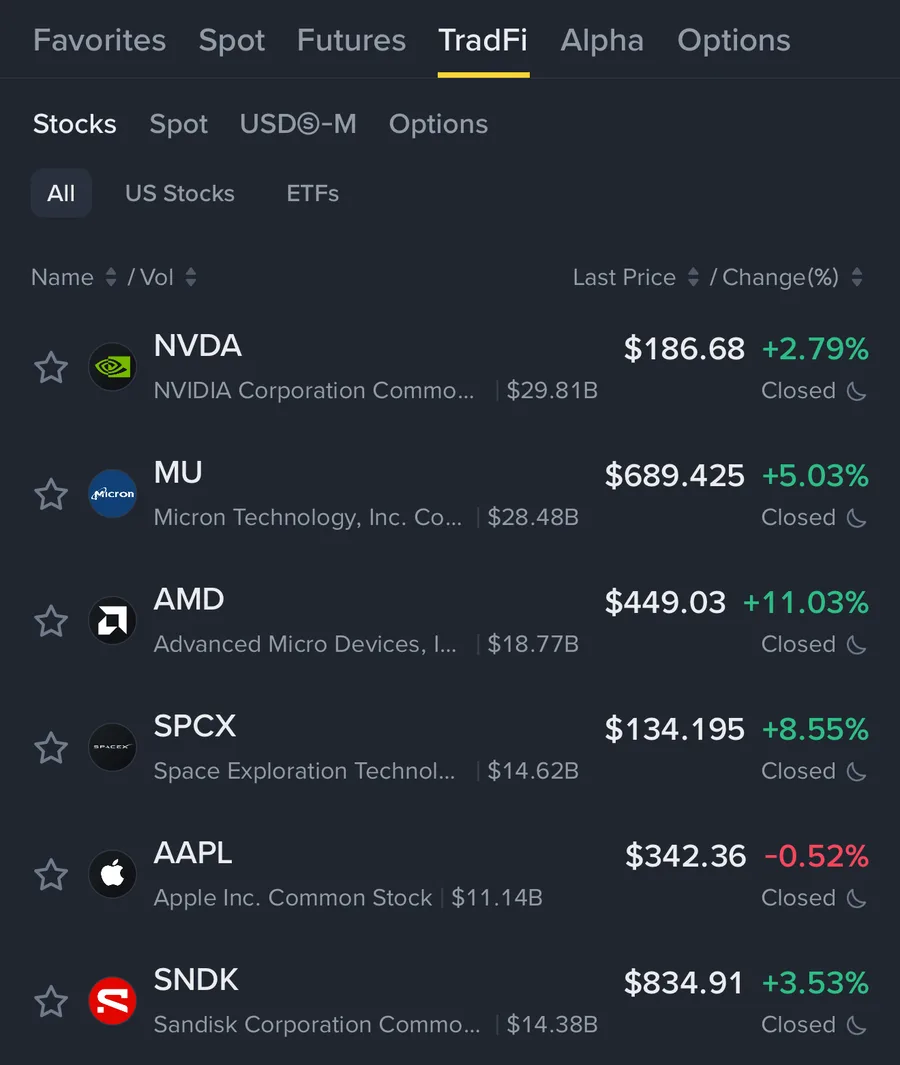
The Binance app’s TradFi tab is split into Stocks, Spot, USDⓈ-M and Options, and the stock perpetuals sit under USDⓈ-M. They launched on January 8, 2026 through Nest Exchange, a Binance entity regulated by the FSRA in Abu Dhabi Global Market (ADGM), and Micron (MUUSDT) and SanDisk (SNDKUSDT) followed on April 7. The other two products are US stock trading, opened on June 1 (Nest Trading takes the order and the US broker Alpaca holds the shares, with dividends paid), and bStocks, tokens launched on June 12 and backed one-to-one by shares, which the release says “are not stocks or shares”.
Counted by each contract’s listing date. Delisted contracts are not in the API, so early months may be slightly low. Hong Kong, Korean and China A-share contracts are excluded.
Source: binance.com
How a stock perpetual works
A perpetual has no expiry date, uses USDT as margin, and lets you go long or short. On Binance’s Micron contract, MUUSDT, the minimum order is 5 USDT and the tick size is 0.01 (Binance API, checked 2026-11-07).
Two mechanisms keep the contract near the share price:
- Index price. During regular US hours, Binance calculates the index every second as a weighted average of prices from several third-party data vendors. Bybit does the same. Liquidation uses the mark price, which is not allowed to drift too far from the index.
- Funding rate. When the contract trades above the index, longs pay shorts; when it trades below, shorts pay longs. Binance’s MU, SNDK, TSLA and NVDA contracts settle funding every 8 hours with a cap of ±2%. When I checked, MUUSDT funding was 0.0168%. If it stayed at that level, three payments a day would come to about 0.05%, or about 1.5% over 30 days. The rate changes, and it can flip so that you receive it instead.
You get none of a shareholder’s rights. Bybit puts it most plainly: the contract does not represent ownership of the underlying and carries no shareholder rights or dividends. Bybit adjusts contracts for corporate actions such as splits, and says the economic effect of dividends is reflected in price and funding through arbitrage. Binance says dividends follow a separate adjustment method, and splits and mergers are handled through separate notices. OKX says it does not currently pay dividends or adjust prices for them; after a split, reverse split or large dividend it may settle and delist the contract.
How prices are set when the US market is closed
The contract trades around the clock; the US market does not. With no new share price, the exchange has to estimate one.
Binance’s FAQ (updated September 23, 2026) sets these rules:
- Pre-market and after-hours. The index is smoothed with a fast-decay EWMA.
- Overnight. A slow-decay EWMA.
- Weekends, holidays and maintenance. An EWMA of the mid price from the contract’s own order book. Stock perpetuals have used this since May 16, 2026; before that the index was held at its last value.
- Maximum distance between mark price and index. ±5% on trading days, ±3% on weekends and holidays, adjustable by Binance in extreme markets.
A separate Binance Academy page still says the index is fixed when the market is closed and gives a ±8% limit on trading days. That conflicts with the FAQ, which is the newer of the two.
Bybit’s method: when the market is closed, price components that stop updating are dropped and the rest are smoothed with an EWMA with a 600-second half-life. The mark price may sit at most 5% from the index for single stocks, and 3% for ETFs and commodities.
The other three: on weekends OKX anchors the index to the last available share price, and the index may not move more than 10% from the traditional market price. When the market is closed, Bitget moves the index with an EMA of the contract’s order book, capped at 10% from the last close. Gate keeps using external quotes for assets that have extended-hours prices; where there are none, it holds the last valid price until the next session.
On weekends the index comes from the contract’s own order book, with no real share price to compare it against. CryptoSlate looked at Binance’s SOXLUSDT from 21:00 to 22:00 UTC on Saturday, October 17, 2026. Within that hour the mark price fell as much as 5.92% from its open and the index fell about 3.97%, with the gap between them staying inside the 3% limit. The ±3% limits how far the mark can sit from the index; the index itself can still move.
When the market opens on Monday or a company reports earnings, the share price can jump a long way at once. Bybit’s risk disclosure lists gaps from earnings and major news as a possible liquidation trigger, and warns that liquidity falls and spreads widen while the underlying market is closed.
Five exchanges compared
The figures come from each exchange’s public API and official pages, checked on November 7, 2026 (Taiwan time); leverage is the cap for the first position tier on the MU contract. Leverage caps, fees and funding caps change often, so check the official page again before you trade.
| Exchange | Stock-type contracts | MU max leverage | Fees | Funding | Index and closed hours |
|---|---|---|---|---|---|
| Binance | 197 US stocks and ETFs, plus 15 Hong Kong and 8 Korean | 50x | Regular users pay 0.02% maker and 0.05% taker on standard USDⓈ-M futures, and TradFi contracts get a discounted rate; an 11/4 notice extended 50% off taker for VIP 4–9 | 8 hours, cap ±2% | Weighted third-party prices; order-book EWMA on weekends |
| Bybit | 210 US stocks, 56 US ETFs | 100x | Same as regular USDT perpetuals, by VIP level | 8 hours, cap ±0.3% | Weighted components; stale components dropped and slow EWMA when closed |
| OKX | About 230 stock-type contracts (incl. ETFs and private companies) | 50x | By VIP level; regular users 0.02% maker, 0.05% taker | 8 hours, cap ±1% | Several price providers; anchored to the last share price on weekends, within 10% of it |
| Bitget | 420 RWA contracts (incl. commodities, FX, stocks from several markets) | 50x | 0.02% maker, 0.06% taker | 8 hours, cap ±1% | Weighted external prices; order-book EMA when closed, within 10% of the last close |
| Gate | 448 stock contracts (several markets) | 75x | Same as regular perpetuals, by VIP level; VIP 0 0.02% maker, 0.05% taker | 8 hours, cap ±1% | Weighted third-party prices; last valid price held when no quote is available |
Contract counts, leverage and funding caps come from each exchange's public API. Binance, Bybit and OKX list their stock contracts as 24/7, and Gate says trading continues while the underlying market is closed. Each exchange groups contracts differently, so the counts are not directly comparable.
Taiwan stocks are listed too. Bitget has contracts such as TWTSMUSDT and TWDELTAUSDT. On November 5 Gate listed six Taiwan-linked contracts, TWDELTA, TWASX, TWUMC, NANYA, WINBOND and YAGEO, with 1x to 20x leverage.
Volume is concentrated on Binance. In August 2026 Binance’s ranking page showed the SNDK perpetual at $7.38 billion of volume in one day, ahead of BTC at $6.11 billion and ETH at $4.57 billion.
- SNDK perpetual volume on Binance in one day in August 2026, ahead of BTC that day
- $7.38B
- SNDKUSDT 24-hour volume on Binance (checked 11/7; BTCUSDT was 13.9B in the same window)
- 4.70B USDT
- MUUSDT 24-hour volume on Bybit (checked 11/7)
- 134M USDT
On thinly traded contracts the order book is even thinner when the market is closed, and an order-book EWMA is easier for a few orders to push around.
- All US stock perps (197)
- BTCUSDT perp
Monthly quote volume summed over Binance’s 197 US stock perpetuals (contracts still trading). In July the total, $296.0bn, passed BTCUSDT’s $272.8bn; in October it was $292.3bn against $334.9bn. November is not over and is left out.
Source: binance.com
Bybit, OKX, Bitget and Gate from their public APIs; Binance’s leverage tiers need a logged-in API, so its figure is the one in the table above.
Source: bybit.com, okx.com, bitget.com, gateio.ws
For comparison, Binance’s BTCUSDT perpetual is capped at ±0.3%. The wider the cap, the more one side can pay in funding in extreme markets.
Source: binance.com, okx.com, bitget.com, gateio.ws, bybit.com
How this differs from tokenized stocks and sub-brokerage
Tokenized stocks are backed by real shares: each Binance bStock maps one-to-one to a share in custody, and Backed’s xStocks went live on Bybit and Kraken on June 30, 2025, so the risk sits with the issuer and custodian. A perpetual has no shares behind it, and the risk sits with leverage and the exchange. Sub-brokerage (複委託) through a Taiwan broker gets you real shares but no margin yet; the regulator plans foreign-currency margin of up to 50%, from the second quarter of 2027 at the earliest.
Main risks
- Liquidation. If the mark price reaches your liquidation price, you can lose all your margin. Bybit’s help page says leverage may cost you your entire margin in a short time. On October 17, SOXL contracts across exchanges saw $11.3 million liquidated in 1,043 events (MarginPad, as cited by CryptoSlate).
- Weekend and earnings gaps. Closed-market prices are the exchange’s estimate, and when the US market opens the contract has to catch up with the real share price.
- Index divergence. The exchange writes the index rules and can change them. In May Binance switched stock perpetuals’ weekend pricing from a fixed index to an order-book EWMA, and its FAQ keeps the right to change deviation limits in extreme markets.
- The exchange itself. Your margin sits on the exchange, so its problems become yours. On October 30 about $6.34 billion was stolen from Binance hot wallets, and withdrawals reopened in batches, with the third batch on November 5. See the Binance incident page and the exchange incident hub (both in Chinese). To check an exchange’s reserves yourself, see the proof-of-reserves page and what to do when an exchange is hacked.
Before you place an order
- Whether your account can trade the contract. OKX’s notice says products are not available in every region and tells you to check in the app.
- Leverage, margin and funding cap. Go by the max leverage, maintenance margin rate and funding cap shown on the order page at that moment.
- Which US session it is. Regular, pre-market or after-hours, overnight, or weekend. The index is calculated differently in each.
- Earnings and weekends. Whether your position will be open over earnings or a weekend.
- Limit the margin you keep there. Only keep as much margin on the exchange as you are willing to expose to exchange risk.
If you want to open a Binance account, the fee discount details are on the Binance page (in Chinese).
Sources
- 1. Binance Futures Launches TradFi Perpetual Contracts
- 2. New Listing Alert: TSLAUSDT
- 3. Binance launches MU and SNDK stock perpetual contracts
- 4. Binance Launches U.S. Stocks Trading and Previews bStocks
- 5. Binance Exchange Launches bStocks Tokenized Securities
- 6. TradFi Perpetuals FAQ
- 7. Binance Futures TradFi Perpetual Contracts
- 8. USDⓈ-M Futures exchangeInfo / fundingInfo / premiumIndex / ticker
- 9. Introduction to TradFi Perpetual Contracts
- 10. New listing: MUUSDT Perpetual Contract, with up to 10x leverage
- 11. V5 instruments-info / tickers
- 12. OKX to list perpetual futures for selected stocks
- 13. Public instruments / funding-rate
- 14. Futures leverage brackets
- 15. TradFi/Stock Perpetuals FAQ
- 16. Traditional Asset Perpetual Futures Overview
- 17. Index Price
- 18. TradFi Perpetual Contracts
- 19. Gate.com Fees Explained: Spot, Futures, Stocks & Trading Fees
- 20. Binance Futures Fee Structure & Fee Calculations
- 21. Bitget Stock Futures: Frequently Asked Questions
- 22. Mix market contracts
- 23. Futures USDT contracts
- 24. Gate Plans 10 Stock Perpetuals, Including Six Taiwan-Linked Contracts
- 25. Binance Extends 50% TradFi Perpetual Fee Discount for VIP Users
- 26. Binance's SOXL mark fell 5.9% despite a 3% price band
- 27. Binance SNDK surpasses BTC and ETH
- 28. Bybit, Kraken list 60 tokenized U.S. stocks via Backed's xStocks
- 29. Kraken acquires Backed after xStocks volumes hit $10 billion
- 30. FSC to allow foreign-currency margin for sub-brokerage, Q2 next year at the earliest (in Chinese)
- 31. NRA withholding
- 32. Binance API
- 33. Bybit API
- 34. Binance USDⓈ-M klines (interval=1M), per symbol
- 35. OKX public instruments MU-USDT-SWAP
- 36. Bitget mix contracts MUUSDT
- 37. Gate futures contract MU_USDT
- 38. Binance fundingInfo
- 39. OKX funding-rate MU-USDT-SWAP
- 40. Bitget current-fund-rate MUUSDT
Kelvin Wang
Electrical engineer building tools with AI agents, sharing hands-on notes on engineering and investing.
More about me