US stocks
How to Buy US Stocks on Binance in 2026: Stock Trading, bStocks, Ondo Tokens and Perpetuals
Binance has four ways to get exposure to US stocks: US stocks held by Alpaca (7,000+ names), bStocks issued by BTech Holdings, Ondo tokenized stocks on Binance Alpha, and stock perpetuals such as Micron (MU). Whether you hold a share, a token or a contract determines dividends, trading hours, fees, leverage and where you can use it.

Kelvin Wang · · 14 min read
Key points
- Only US stock trading gives you the share itself: Nest Trading takes the order, Alpaca holds the shares, and dividends are paid after a default 30% US withholding.
- bStocks and Ondo tokens are backed by shares, but holders don't own those shares directly, which adds an issuer and custody layer.
- Only perpetuals allow shorting and leverage, but they come with no shares or dividends, and the exchange estimates the price while the US market is closed.
- None of the four is offered in the US, and Binance has no MiCA authorization in the EU, where ESMA told unauthorized providers to stop onboarding new clients from July 1, 2026.
Each route gets you something different. With US stock trading you buy real shares held by the US broker Alpaca and receive dividends. A bStock is a token issued by a Binance affiliate: one share stands behind each token, but the holder doesn’t own that share directly. Ondo’s tokenized stocks sit on Binance Alpha and Binance Wallet, not on the main spot market. A stock perpetual is a derivative that tracks the share price with no shares behind it, and you can trade it with leverage.
- US stocks and ETFs available through Binance's US stock trading (June 1, 2026 press release)
- 7,000+
- Minimum fractional order for US stocks and bStocks
- US$5
- Binance US stock perpetuals at the end of October 2026
- 197
On my Taiwan-verified account, checked on November 9, 2026, the Binance app shows both US stocks and bStocks.
How do the four ways compare?
| Route | What you hold | Dividends | Trading hours | Costs | Leverage |
|---|---|---|---|---|---|
| US stocks (TradFi → Stocks) | Shares, ordered through Nest Trading and held by Alpaca | Yes, 30% US withholding by default | US market hours; some stocks 24/5 | 0.10% spread on orders of US$340 and above, US$0.35 platform fee below that; 0.05% and US$0.17 until 2026-12-31 23:59 UTC | None |
| bStocks (e.g. TSLAB/USDT) | BEP-20 tokens issued by BTech Holdings, backed 1:1 by shares in custody | Adjusted automatically by the issuer, not paid out separately | 24/7 | Free 1:1 conversion with the share; zero maker fees on the first pairs for a limited time | None |
| Ondo tokenized stocks (e.g. AAPLon) | Note-type tokens issued by Ondo Global Markets (BVI), backed by the corresponding shares | Not paid out; reinvested after 30% withholding and reflected in the token price | Issuer side follows US 24/5 sessions; a few names also trade on weekends | Spread built into Ondo's quote; you pay network fees; direct redemption through Ondo 0.05% | None |
| Stock perpetuals (e.g. MUUSDT) | A derivative that tracks an index, no shares | None; Binance has a separate dividend adjustment method | 24/7, priced by other methods while the market is closed | Maker and taker fees plus funding every 8 hours | Up to 50x on MU |
bStocks and US stock rules from Binance's June 2026 press releases; US stock fees from Binance's Stocks fee page (2026-11-17); perpetual figures from Binance's futures API and Leverage & Margin page (2026-11-17). Ondo's issuance, dividend and trading-hour rules from Ondo's official documentation (checked 2026-11-17).
For real shares and dividends, look at US stock trading. For 24-hour trading or a position you can move to your own on-chain wallet, look at bStocks. Only perpetuals let you short or use leverage. Ondo tokens reinvest dividends automatically, which suits holders who want the position in an on-chain wallet without handling payouts.
What happened with Binance and US stocks in 2026?
- Warning or reduced service
- Positive step
-
2026-01-08
TradFi perpetuals launch, starting with gold and silver.
Offered by Nest Exchange, a Binance entity regulated by the Financial Services Regulatory Authority (FSRA) of Abu Dhabi Global Market (ADGM).
-
2026-01-28
Tesla perpetual TSLAUSDT launches.
-
2026-02-24
Ten Ondo tokenized US stocks and ETFs list on Binance Alpha and Binance Wallet.
Including AAPLon, GOOGLon, TSLAon, NVDAon and QQQon; not available to US users. Binance's first tokenized stocks since it discontinued stock tokens in 2021.
-
2026-04-07
Micron MUUSDT and SanDisk SNDKUSDT perpetuals launch.
Up to 10x leverage at launch.
-
Warning or reduced service: 2026-05-16
Weekend index for stock perpetuals switches to the contract order book's mid price.
Before this, the index was held at its last value while the market was closed.
-
2026-05-21
SpaceX pre-IPO perpetual SPCXUSDT launches.
Date taken from the listing time in Binance's futures API.
-
Positive step: 2026-06-01
US stock trading opens, with more than 7,000 US stocks and ETFs.
The same press release said bStocks would follow "in the coming weeks".
-
Positive step: 2026-06-12
bStocks launch, starting with CRCLB, MUB, NVDAB, SNDKB and TSLAB.
How does Binance’s US stock trading work?
US stock trading, which opened on June 1, is the only one of the four that gives you the shares directly. Nest Trading Limited, Binance’s broker in ADGM, takes your order and passes it to the US broker Alpaca for execution, clearing, settlement and custody; the press release states that Binance itself does not handle or hold your securities 1. Holders receive dividends and take part in corporate actions such as stock splits.
The press release sets out these rules 1:
- What you can buy. More than 7,000 US-listed stocks and ETFs, with fractional shares from US$5.
- Trading hours. Some stocks trade 24/5; the rest follow US market hours.
- Payment currencies. Mainly USDC, with BNB, USDT, USD1 and $U also accepted. Sale proceeds always come back as USDC.
- Securities lending. Fully Paid Securities Lending (FPSL) lets you lend out your holdings.
The press release says “zero commission,” but the fee page adds a spread on larger orders and a flat platform fee on smaller ones, so you still pay to trade. Binance’s Stocks fee page listed the following on November 17, 2026 17:
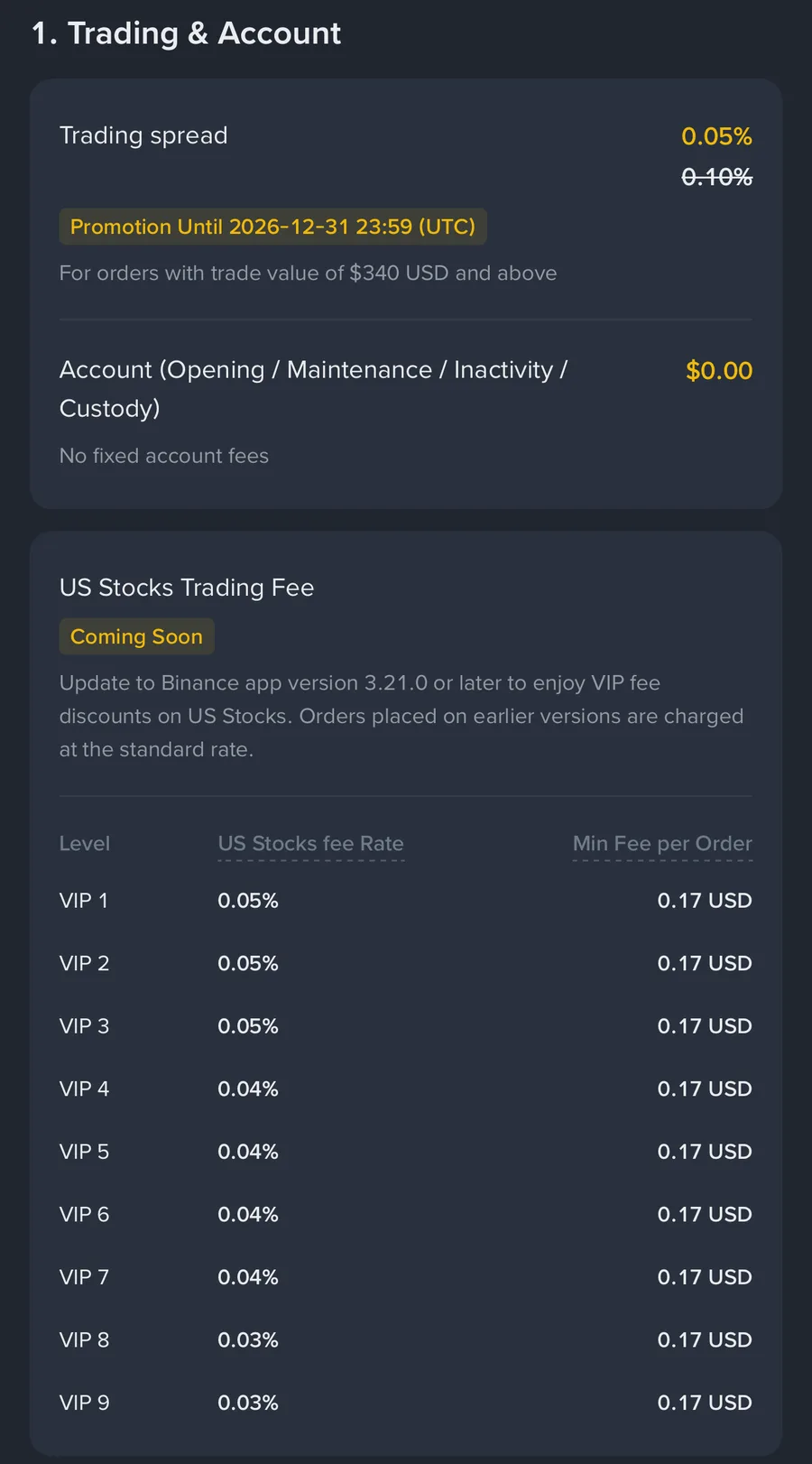
- Trading spread. 0.10% on orders of US$340 and above, discounted to 0.05% until 2026-12-31 23:59 UTC.
- Platform fee. US$0.35 per order on orders of US$340 and below, discounted to US$0.17 over the same period. This row was not on the app fee page I photographed on November 7, where the spread was the only trading charge shown.
- Account fees. No charge for opening, maintenance, inactivity or custody. Binance absorbs the US Securities and Exchange Commission (SEC) and FINRA fees on sales.
- Currency conversion. Trades settle in US dollars and USDC to USD is free; orders paid in USDT, USD1, USDU or BNB are first converted to USDC at the market rate.
- Dividend tax. Dividends are credited after a default 30% US withholding.
- VIP rates. The app showed a separate table on November 7: 0.05% for VIP 1–3, 0.04% for VIP 4–7 and 0.03% for VIP 8–9, with a minimum of US$0.17 per order. It was marked “Coming Soon” and required app version 3.21.0 or later. The web fee page on November 17 lists no VIP rates.
The charge changes when an order crosses US$340. Here is what three order sizes cost at the current promotional rates:
| Order size | Charge that applies | Buy cost | Buy and sell |
|---|---|---|---|
| US$100 | US$0.17 platform fee (promotion) | US$0.17 | US$0.34 |
| US$1,000 | 0.05% spread (promotion) | US$0.50 | US$1.00 |
| US$10,000 | 0.05% spread (promotion) | US$5.00 | US$10.00 |
Calculated from Binance's Stocks fee page (2026-11-17); SEC and FINRA fees on sales are absorbed by Binance, so they are not added. The promotion runs until 2026-12-31 23:59 UTC; after that the figures become US$0.35 and 0.10%. If you fund with USDT, the market spread on converting to USDC comes on top.
What are bStocks?
bStocks launched on June 12. The issuer is BTech Holdings Limited, a Binance group affiliate, and the FSRA in ADGM approved its prospectuses 2. They are offered to the public only in ADGM under those prospectuses; elsewhere, eligible users in “permitted jurisdictions” can trade them on a secondary-market basis only, and they are not available to US persons 2.
The press release explains how they work 2:
- Backing. Each bStock is backed by one corresponding share held by a custodian; the underlying shares are bought through Nest Trading.
- Not shares. The release says outright that “bStocks are not stocks or shares”: holders don’t own the share directly, and the issuer and custodian add a layer of risk.
- Corporate actions. The issuer processes splits and dividend adjustments automatically by changing the token amount or value, so you don’t need to do anything.
- Trading and withdrawal. They trade 24/7. They are BEP-20 tokens on BNB Chain and can be withdrawn to your own BNB Chain wallet.
- Costs. Conversion between shares and bStocks is 1:1 with no conversion fee; the first pairs had zero maker fees for a limited time, under the campaign terms. Fractional orders start at US$5.
The first five were CRCLB, MUB, NVDAB, SNDKB and TSLAB, all against USDT. The June 12 release described SpaceX’s SPCXB as “planned for trading, pending SpaceX’s public listing on Nasdaq”; Binance’s spot API shows daily candles from June 12, and on November 17, 2026 SPCXB/USDT was trading 10. My Taiwan-verified account also shows SPCXB among the bStocks in the app.
Because bStocks can be withdrawn on-chain, you have to pick the right network. BEP-20 is a different network from TRC20 and ERC20, the networks USDT often uses, and a transfer on the wrong one won’t arrive. What is USDT? explains the differences.
Go deeper What Is USDT? TRC20 vs ERC20 and USDT vs USDC (2026) The USDT you fund with, the USDC you get back when you sell, and how to choose a chain for transfers.How do Ondo tokenized stocks on Binance Alpha work?
On February 24, 2026, Binance listed ten tokenized US stocks and ETFs from Ondo Global Markets, including AAPLon, GOOGLon, TSLAon, NVDAon and QQQon 3. They sit on Binance Alpha and Binance Wallet, not the main spot market, and are not available to US users. Binance calls them “digital securities” and cites ADGM FSRA approvals. They are Binance’s first tokenized stocks since it discontinued stock tokens in 2021 amid regulatory scrutiny.
Ondo Global Markets launched in September 2025, and Ondo reports more than US$550 million in total value locked and more than US$11 billion in cumulative volume 3. Besides Binance, the tokens trade on Gate, Bitget and MetaMask.
Ondo’s documentation describes them this way:
- Legally a note. Each token is a structured note issued by Ondo Global Markets (BVI) Limited, a special purpose vehicle in the British Virgin Islands. Holders can redeem, but have no shareholder voting or information rights 11.
- Backing and custody. Tokens are backed one-to-one by the corresponding shares plus a buffer, held with one or more US-registered broker-dealers; Ankura Trust, an independent agent, holds a first-priority security interest and checks the holdings daily 1114.
- Dividends. No cash is paid out. After 30% US withholding, the rest is reinvested in the same stock and reflected in the token price, so over time one token can represent more than one share and its price drifts away from the share price 1213.
- Trading hours. The issuer side runs from 8:05 pm Sunday to 7:59 pm Friday New York time (01:05 Monday to 00:59 Saturday UTC in winter, an hour earlier in summer), in pre-market, regular, post-market and overnight sessions; a few names also trade on weekends and US market holidays 15.
- Costs. Ondo keeps the difference between its quoted price and what it pays for the shares, and you pay your own network fees; other platforms may charge more on top. Direct redemptions through Ondo incur a 0.05% fee; secondary-market trading fees depend on the platform 13.
I found no Binance announcement of Ondo tokens moving to the main spot market.
How do Binance’s US stock perpetuals work?
Stock perpetuals sit in the USDⓈ-M futures section, use USDT as margin, can go long or short, and never expire. The price follows an index Binance builds from several price feeds, and a funding payment every 8 hours pulls the contract back toward the index. Binance had 197 US stock perpetuals at the end of October 2026 and 199 on November 17, after two more listings in November 5. On Micron’s MUUSDT, positions up to US$50,000 in notional value can use up to 50x leverage 22, and the regular funding rate is capped at ±2% per 8-hour interval 23 (both checked 2026-11-17); special dividend adjustments are settled separately and can exceed that cap 24.
The biggest difference from the other three is what happens when the US market is closed. The contract keeps trading. During pre-market, after-hours and overnight sessions, the index is smoothed; on weekends and holidays it switches to the contract’s own order-book mid price. The mark price may deviate from the index by no more than ±5% on trading days and ±3% on weekends and holidays 7. When the market opens on Monday or after earnings, the contract has to catch up with the real share price, and that is when gaps and liquidations happen.
Pre-IPO companies have contracts too. SPCXUSDT is a “Pre-IPO perpetual” that launched before SpaceX listed; Binance’s API gives its listing time as May 21, 2026 56.
I cover leverage, funding, the closed-market index methods and a five-exchange comparison in a separate article.
Go deeper Can You Trade US Stocks on Binance? Stock Perpetual Futures Compared (2026) Stock contract counts, leverage, funding and closed-market rules on Binance, Bybit, OKX, Bitget and Gate.If you trade perpetuals through code, give the API key read and trade permissions only, never withdrawal, and restrict it to a fixed IP address; see How to set up exchange API keys safely.
What does Micron (MU) look like in each form?
The same stock can exist on Binance in several forms at once. Take Micron as an example:
US stock MU
Find it in the stock list under TradFi → Stocks. You buy Micron shares held by Alpaca, with dividends after a default 30% US withholding. It trades during US market hours unless it is on the 24/5 list. The charge is a 0.10% spread on orders of US$340 and above or a US$0.35 platform fee below that, discounted to 0.05% and US$0.17 until the end of 2026.
bStock MUB
MUB/USDT was one of the first bStocks pairs. It trades 24/7 and can be withdrawn to a BNB Chain wallet; the issuer adjusts the token for dividends. You hold a BTech Holdings token, not Micron shares.
Perpetual MUUSDT
Launched April 7, 2026 in the USDⓈ-M futures section. No shares and no dividends; you can short it, with up to 50x leverage and funding settled every 8 hours. On weekends the price comes from the order book.
Where are these products available?
The press releases for US stock trading and bStocks only say they are for eligible users in “permitted jurisdictions”, and both name the United States as excluded without listing other countries 12. The bStocks release also says the prospectuses are approved only in ADGM and that no public offer is made in any other jurisdiction. Binance’s Stocks fee page says stock trading “is available to eligible users in supported jurisdictions” 17. Binance’s FAQ for stock perpetuals doesn’t say which countries can trade them 7. Binance’s List of Prohibited Countries bars people in the United States (and US citizens wherever they live), Canada, the Netherlands, Cuba, North Korea, Iran, Crimea and the so-called Donetsk and Luhansk People’s Republics from opening any Binance account 21. My Taiwan-verified account shows US stocks and bStocks in the app.
In the EU, the issue is Binance as a whole. ESMA’s register of MiCA-authorized crypto-asset service providers lists no Binance entity 19. Binance withdrew its MiCA application in Greece, said it would seek authorization in another member state, and said some users “may be impacted depending on their country and account status” 18. ESMA said that once the transition period ended on July 1, 2026, unauthorized providers had to stop onboarding new EU clients and limit existing clients to selling, transferring or closing positions 20.
Ondo’s official eligibility page sets its own rules 16:
- Prohibited. The United States, Canada, Russia, Belarus, Iran, North Korea, Cuba, Syria, Afghanistan, Libya, Myanmar, Somalia, Sudan, South Sudan, and the occupied regions of Ukraine.
- Restricted (eligibility requirements apply). Brazil, every member state of the European Economic Area, Hong Kong, Malaysia, Singapore, Switzerland and the United Kingdom.
- Taiwan. Not on either list.
Where does the risk sit?
Each product puts the risk in a different place:
- US stocks. The shares are at Alpaca, orders go through Nest Trading, and deposits and withdrawals go through Binance. A problem with accounts or service at any of the three affects you.
- bStocks. This adds the issuer, BTech Holdings, and the custodian, and the token’s value depends on them keeping it 1:1. Once you withdraw on-chain, the wallet and private key are your responsibility.
- Ondo tokens. Legally a note from a BVI special purpose vehicle, so its value depends on the issuer, the US custodial broker-dealers and the security agent Ankura Trust; after withdrawing on-chain you manage the private key yourself.
- Perpetuals. Liquidation from leverage, gaps after the market reopens, and gaps between the contract price and the real share price.
All four run through a Binance account. At the end of October 2026, Binance’s hot wallets were hacked and withdrawals reopened in batches; see the Binance incident page (in Chinese). For what to do when an exchange is hit, see Exchange hacked? 5 steps.
Leveraged contracts can wipe out your margin in a very short time, and tokenized stocks carry issuer and custody risk on top. The rules and figures here are compiled from public sources and are not investment advice.
FAQ
Where can you buy US stocks on Binance?
Binance publishes no list of countries for these products, but its account-level prohibited list covers the US, Canada and the Netherlands, among others 21. I checked with a Taiwan-verified account: US stocks appear under TradFi → Stocks in the app, and so do bStocks. Binance has no MiCA authorization in the EU 19, and ESMA told unauthorized providers to stop onboarding new EU clients from July 1, 2026 20. Stock perpetuals sit in the futures section and are a different product from the shares.
Can Binance US stocks and bStocks be converted into each other?
The June 12 press release says shares and bStocks convert 1:1 with no conversion fee 2. It doesn’t say how this works in the app.
Can I buy Binance US stocks with USDT?
Yes, but the USDT is first converted to USDC at the market rate 17, and sales pay out in USDC 1. To trade US stock prices directly in USDT, use the perpetuals or the bStocks USDT pairs.
Can bStocks trade on weekends?
Yes. bStocks are tokens that trade 24/7 2, but the underlying shares don’t trade while the US market is closed, so weekend prices reflect only buying and selling in the token market. US stock trading follows US market hours, with some stocks 24/5.
How is Binance different from buying US stocks through a local broker?
Both get you real shares, but the custody chain differs. On Binance, Nest Trading takes the order, Alpaca holds the shares, and you fund with USDC. Through a local broker (in Taiwan this is called sub-brokerage), the broker places the order with an overseas broker, you settle in local or foreign currency, and local securities law applies. The fee structure differs too: Binance charges a 0.10% spread on orders of US$340 and above or a US$0.35 platform fee below that (0.05% and US$0.17 until the end of 2026) 17, while broker fees and minimums vary by broker.
Do Binance US stocks pay dividends?
Yes. The press release says holders are eligible for dividends and corporate actions 1, and the fee page says dividends are credited after a default 30% US withholding 17. bStocks are adjusted by the issuer instead, and perpetuals pay no dividends.
If Binance is available where you live, fee discount details are on the Binance page (in Chinese).
Sources
- 1. Binance Launches U.S. Stocks Trading and Previews bStocks
- 2. Binance Exchange Launches bStocks Tokenized Securities
- 3. Binance brings back tokenized stocks via Ondo Finance partnership
- 4. Binance Futures Launches TradFi Perpetual Contracts
- 5. USDⓈ-M Futures exchangeInfo
- 6. Binance launches SpaceX-linked perpetual futures ahead of potential IPO
- 7. TradFi Perpetuals FAQ
- 8. Binance launches MU and SNDK stock perpetual contracts
- 9. New Listing Alert: TSLAUSDT
- 10. Spot exchangeInfo / klines SPCXBUSDT
- 11. Ondo Stocks: Legal & Regulatory
- 12. Ondo Stocks: Corporate Actions
- 13. Ondo Stocks: Fees & Taxes
- 14. Ondo Stocks: Trust & Transparency
- 15. Ondo Stocks: Market Hours & Trading Availability
- 16. Ondo Stocks: Eligibility
- 17. Fees & Transactions Overview: Stocks
- 18. Important Update for Our European Users
- 19. Interim MiCA register: authorised crypto-asset service providers (CASPS.csv)
- 20. ESMA public statement on the end of the MiCA transitional period
- 21. List of Prohibited Countries
- 22. USDⓈ-M Futures Leverage & Margin
- 23. USDⓈ-M Futures fundingInfo
- 24. Dividend adjustment for equity perpetual contracts
Kelvin Wang
Electrical engineer building tools with AI agents, sharing hands-on notes on engineering and investing.
More about me