Crypto, the big picture
What Is USDT? TRC20 vs ERC20 and USDT vs USDC (2026)
USDT (Tether) is a stablecoin pegged 1:1 to the US dollar, and the same USDT runs on several chains such as TRC20, ERC20 and BEP20. Which chain to use depends on what the receiver accepts and what the withdrawal fee is. USDC is issued by Circle, a US-listed company that complies with the EU's MiCA rules; USDT was delisted in the EU.

Kelvin Wang · · 9 min read
Tether designs USDT so that 1 USDT equals 1 US dollar, and says every token is backed by reserve assets of equal value. The same USDT is issued on several blockchains: TRC20 is the version on Tron, ERC20 the version on Ethereum. They are worth the same, but addresses, fees and confirmation times differ, and both ends of a transfer must use the same chain. USDC is a dollar stablecoin from a different company, Circle, which is listed in the US and holds a MiCA licence in the EU. USDT has no MiCA licence, and EU exchanges began delisting it in 2025.
- USDT in circulation (2026-11-05 23:30 UTC)
- ~$177.7B
- Share of circulating USDT on Tron
- 52%
- Tether's assets in excess of liabilities (2026-09-30)
- $7.95B
How USDT holds $1
Tether says USDT is pegged 1:1 to the dollar and backed by Tether’s reserves, and that it is fully reserved as long as the USDT in circulation does not exceed the reserves.
The peg works through issuance and redemption. Verified customers can send dollars to Tether for new USDT, or hand USDT back for dollars. The bar is high: at least $100,000 per transaction, a 0.1% fee to acquire, the greater of 0.1% or $1,000 to redeem, and a 150 USDT verification fee. Most people never touch that window and trade on exchanges instead. When the market price drifts from $1, large holders who can redeem have an arbitrage that pulls it back. That keeps USDT close to $1 most of the time, but not at every moment: CoinGecko quoted it at $0.9991 on 7 November 2026.
Reserves on 30 September 2026, per Tether management’s assertion and BDO’s attestation: total assets $191.45 billion, total liabilities $183.50 billion, of which $183.47 billion was tokens issued, leaving about $7.95 billion. The assets included about $122.8 billion in US Treasury bills and $16.7 billion in reverse repos, plus about $19.1 billion in gold, $8.4 billion in bitcoin and $14.2 billion in secured loans.
The report is an ISAE 3000 attestation. It confirms assets and liabilities at one point in time, 30 September, and is not a full financial audit. Tether’s transparency data for 5 November 2026 shows about $177.7 billion in circulation, roughly $5.7 billion less than at the end of September.
- US Treasury bills
- Gold
- Reverse repos
- Secured loans
- Bitcoin
- Other
Total assets $191.45bn (BDO attestation). "Other" is total assets minus the five items shown.
Source: stablecoininsider.org, tether.io
What Tether has been fined for
-
2021-02-23
Bitfinex and Tether settle with the New York Attorney General for $18.5 million.
The NYAG found that from no later than mid-2017 Tether at times had no bank access and at times did not hold reserves backing tethers 1:1. The settlement bars them from trading with New Yorkers and requires Tether to publish its reserves by category.
-
2021-10-15
The CFTC fines Tether $41 million and Bitfinex $1.5 million.
In a 26-month sample from 2016 to 2018, Tether held enough fiat reserves to back the USDT in circulation on only 27.6% of days.
-
2024-07-01
Circle's French subsidiary receives an e-money licence, so USDC and EURC can be issued in the EU under MiCA.
Circle said at the time that USDC was the only top-ten stablecoin by market cap that complied with MiCA.
-
2025-01-17
ESMA tells EU platforms to stop offering trading in stablecoins without a MiCA licence by the end of Q1 2025.
Platforms could keep sell-only services until the end of March so users could exit. Coinbase, Kraken and others delisted USDT.
-
2025-06-04
Circle prices its IPO at $31 a share and lists on the NYSE the next day as CRCL.
Circle
-
2025-07-18
The US president signs the GENIUS Act, the first federal stablecoin law.
It requires full backing with liquid assets and monthly public reserve disclosures.
-
2026-01-27
Tether launches USAT, a US stablecoin issued by Anchorage Digital Bank, which the OCC supervises.
Tether's own Tether Operations is not the issuer of USAT. Decrypt reports that USDT's reserves do not currently meet GENIUS Act standards, and the deadline for foreign issuers to comply is still disputed.
On 7 November 2026, USAT existed only on Ethereum, with about $180 million in circulation, nearly a thousand times smaller than USDT.
USDT vs USDC
| Item | USDT | USDC |
|---|---|---|
| Issuer | Tether (private) | Circle (NYSE-listed, CRCL) |
| Circulation (2026-11-07) | ~$177.6B | ~$70.4B |
| Reserves | Mostly US Treasury bills, plus gold, bitcoin and secured loans | Mostly the Circle Reserve Fund managed by BlackRock; the rest cash at banks |
| Third-party assurance | Quarterly attestation by BDO | Monthly attestation by a Big Four firm |
| EU | No MiCA licence; delisted by exchanges | Issued under MiCA |
| US | USDT not yet GENIUS-compliant; USAT launched separately | Circle is a US company |
| Main chains | Tron, Ethereum | Ethereum, Solana |
Circulation: CoinGecko; USDC reserves and assurance: Circle transparency page; chain split: DefiLlama.
USDT’s circulation is more than twice USDC’s, so its markets are deeper. USDC’s strengths are the issuer’s transparency and regulatory standing: Circle is a listed company that files quarterly reports with the SEC, and most of its reserves sit in a regulated money market fund. Tether has a record of fines, and its reserves include assets whose prices move, such as bitcoin, gold and loans.
Both issuers can freeze tokens. After Binance was hacked on 29 October 2026, Tether said it froze more than $1.5 billion in USDT, and Circle froze related USDC; the incident is covered on the Binance hack page. Freezing can stop stolen funds. It also means the issuer can freeze any address that holds its token.
In my own quant trading I have used both USDT and USDC as margin.
- USDT
- USDC
USDT peaked near $189.6bn at the end of April 2026 and has eased since; on November 7 it stood at $177.0bn against USDC’s $70.6bn. DefiLlama’s figures differ slightly from Tether’s transparency page and CoinGecko.
Source: llama.fi
TRC20, ERC20, BEP20: which chain
TRC20, ERC20 and BEP20 are token standards on Tron, Ethereum and BNB Chain. All three carry USDT of equal value, but they don’t connect to each other, and address formats, fees and speed differ. BNB Chain is a special case: Tether’s issuance data does not list BNB Chain, and the USDT there is generally listed as a version bridged by Binance.
Withdrawing from an exchange, you pay the withdrawal fee the exchange sets. Sending from your own wallet, you pay the network fee, in the chain’s native coin: TRX on Tron, ETH on Ethereum, BNB on BNB Chain. A wallet holding only USDT and no TRX cannot send TRC20 USDT, because contract calls on Tron consume energy, and when energy runs short TRX is burned.
USDT withdrawal fees read from each exchange’s public API on 16 November 2026, in USDT:
| Chain | Network fee paid in | MAX | BitoPro | Bitget | KuCoin |
|---|---|---|---|---|---|
| TRC20 (Tron) | TRX | 3 | 2.5 | 1.5 | 1.99 |
| ERC20 (Ethereum) | ETH | 0.4 | 0.3 | 0.6 | 5.5 |
| BEP20 (BNB Chain) | BNB | 0.02 | 0.1 | 0.01 | 1 |
| Polygon | POL | 0.02 | 0.1 | 0.07 | 0.8 |
| Arbitrum | ETH | 0.11 | not listed | 0.1 | 1 |
| Solana | SOL | not listed | not listed | 0.5 | 1.5 |
| TON | TON | not listed | not listed | 0.15 | 0.5 |
Sources: public APIs of MAX, BitoPro, Bitget and KuCoin. The same data shows BitoPro accepting USDT deposits on four chains: TRC20, ERC20, BEP20 and Polygon. Fees change; check the amount on the exchange's withdrawal page before sending.
TRC20 is often called the cheapest option, but not when you withdraw from an exchange. All four exchanges charge 1.5 to 3 USDT for TRC20 withdrawals, while MAX and BitoPro charge under 0.5 USDT for ERC20. Exchanges set these fees themselves, and they don’t always track the actual network cost.
On speed, Tron produces a block every 3 seconds, Ethereum runs 12-second slots, and BNB Chain moved to 0.75-second blocks in June 2025. How long a deposit takes depends mostly on how many confirmations the receiving exchange requires. MAX requires 20 for TRC20, 64 for ERC20 and 15 for BEP20, which works out to about 1 minute, about 13 minutes and a dozen or so seconds.
Choosing a chain, in order:
- Check which chains the receiver accepts deposits on. BitoPro’s public API showed USDT deposits open on four chains on 16 November: TRC20, ERC20, BEP20 and Polygon, so pick one of those four to send to BitoPro.
- Among chains both sides support, compare withdrawal fees.
- If the receiver is your own wallet, make sure it holds that chain’s native coin, or you won’t be able to move the USDT out later.
- Check the USDT contract address. On Ethereum it is
0xdAC17F958D2ee523a2206206994597C13D831ec7; on Tron,TR7NHqjeKQxGTCi8q8ZY4pL8otSzgjLj6t. A token called USDT at a different contract address is a copy someone else issued.
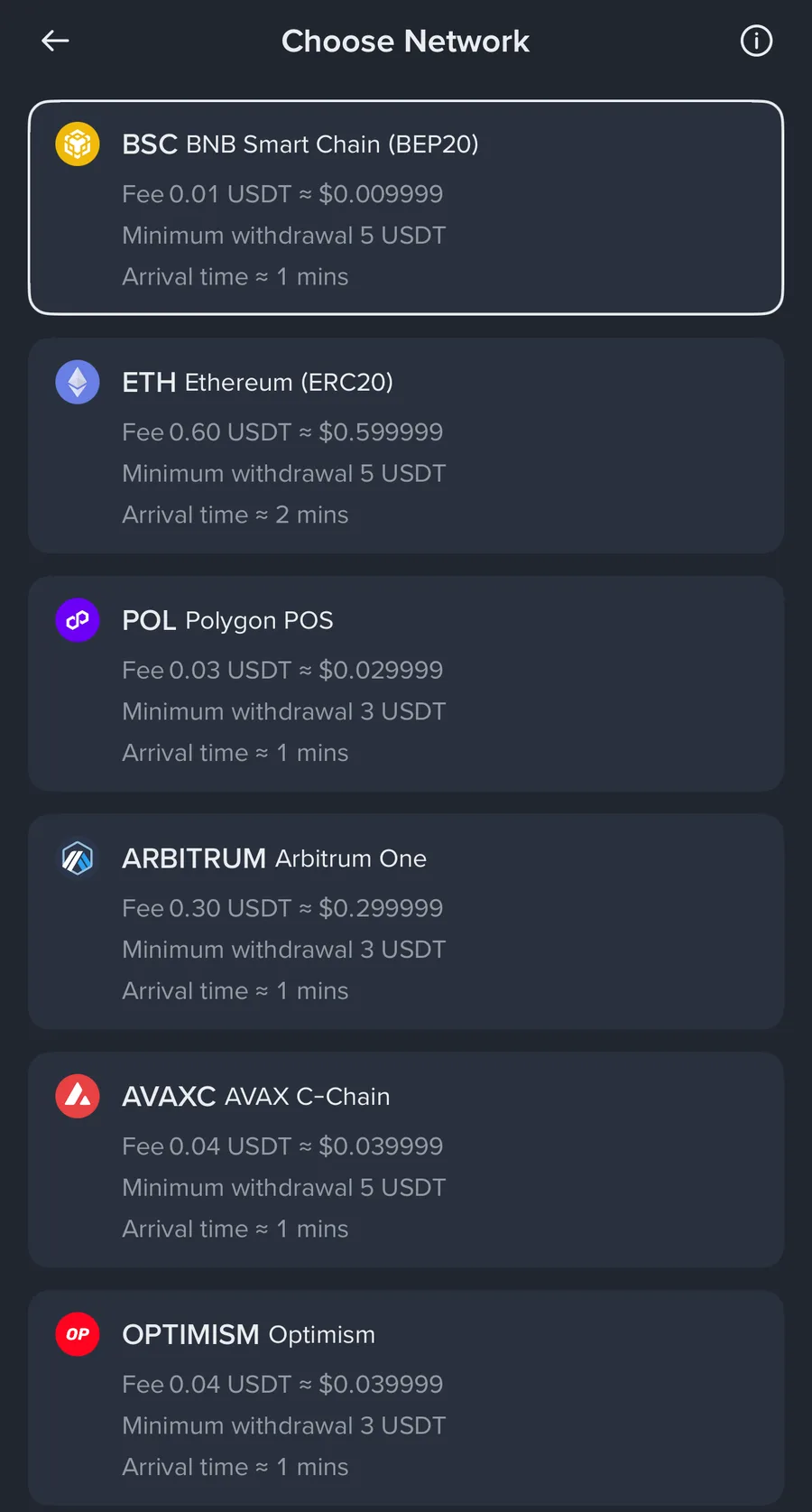
Here is the network menu I see when withdrawing USDT in the Binance app (November 7, 2026): 0.01 USDT on BEP20, 0.60 on ERC20, 0.03 on Polygon, 0.30 on Arbitrum, and 0.04 each on Avalanche C-Chain and Optimism. The minimum withdrawal is 3 to 5 USDT and the estimated arrival time is 1 to 2 minutes.
- Tron
- Ethereum
- BNB Chain
- Solana
- Other
USDT on BNB Chain is Binance’s bridged version and is not on Tether’s transparency page; DefiLlama counts it and subtracts the same amount from Ethereum, so Ethereum looks smaller here than on Tether’s page.
Source: llama.fi, tether.to
- MAX
- BitoPro
- Bitget
- KuCoin
- Binance
"—" means the chain isn’t offered (BitoPro has no Arbitrum) or wasn’t on my screenshot (Binance TRC20). MAX, BitoPro, Bitget and KuCoin are from their public APIs; Binance is what I saw on the app’s withdrawal page.
Source: maicoin.com, bitopro.com, bitget.com, kucoin.com
What happens if you pick the wrong chain
Ethereum, BNB Chain, Polygon and Arbitrum share the same 0x address format. A wallet will let you send BEP20 USDT to an address that only accepts ERC20 deposits; the transaction succeeds on chain and the exchange never credits it.
Whether you can get it back depends on whether the receiving exchange supports that chain and what it charges for recovery. The official recovery rules of 14 exchanges are collected in Wrong chain or missing memo: can you get it back?
Common USDT scams in Taiwan
Police advice: anything promising guaranteed profit or unusually high returns, asking you to use crypto, or telling you to download an unofficial investment platform is very likely a scam; call 165 or a police station before investing.
Fake investments
A case the Criminal Investigation Bureau described in January 2026: the victim met someone on a dating app, moved to LINE, and was told to download a fake shopping app that supposedly paid extra rewards for paying in crypto. He bought about NT$10,000 of USDT on a trading app and deposited it. The first “reward” withdrawal worked. He then put in about NT$3.2 million and could not withdraw it. A small early payout followed by pressure to deposit more is the standard pattern.
Address poisoning
The scammer generates an address that starts and ends like one you use, then sends your wallet a tiny or zero-value transfer from it so the fake address shows up in your history. Copy an address from that history later and you may paste the fake one. Etherscan counted about 17 million such attempts against 1.3 million Ethereum users between July 2022 and June 2024, with at least $79.3 million in confirmed losses. The defence is to copy the address fresh from the receiver’s deposit page every time and check all of it, middle included.
Currency exchange and cash meet-ups
In January 2025 the Criminal Investigation Bureau said unregistered individual dealers advertising cash meet-ups online, taking cash and sending USDT to a designated address, are operating illegally. In one Wanhua dealer it raided, about a third of the 100-plus customers were fraud victims whose money went to scam wallets.
Buying and selling USDT for TWD in Taiwan
The most direct way to swap NT dollars for USDT in Taiwan is a domestic exchange such as MAX or BitoPro: deposit TWD, then trade the USDT/TWD pair.
If you already hold US dollars, there is another route. On 21 October 2026 BitoPro and Far Eastern Bank’s Bankee launched a USD-to-USDT service: you top up US dollars through the dedicated BitoPro X Bankee settlement account and convert them straight to USDT, without going through TWD. It runs around the clock, USD and TWD top-up and withdrawal limits are counted separately, and the USD-to-USDT fee was halved until 31 October.
USDT’s TWD price roughly follows the USD/TWD exchange rate, with small gaps between exchanges. At 2:38 am on 7 November 2026, the last USDT/TWD trade was 32.826 on MAX and 32.827 on BitoPro.
P2P means trading directly with another user: the platform holds the USDT in escrow, and the buyer wires NT dollars straight to your account. You can’t see where that money came from, which is where the watch-list risk above comes from.
How Taiwan regulates USDT: the Virtual Asset Service Act
Taiwan’s legislature passed the Virtual Asset Service Act (虛擬資產服務法) on its third reading on 30 June 2026, and it was promulgated on 22 July (Presidential Order 華總一經字第 11500067161 號). It moves virtual asset businesses to prior licensing. The Executive Yuan will set the date it takes effect, and has not done so yet (Article 56, Presidential Office Gazette).
On stablecoins:
- Issuers need a licence and full reserves. Issuing a stablecoin in Taiwan requires a licence, which can only be granted with the central bank’s consent (Article 34). Issuers must hold full reserves at domestic financial institutions, kept separate from their own assets, entirely in trust with a financial institution, and audited regularly (Article 36, Presidential Office Gazette).
- USDT and USDC need approval for trading. They are not issued in Taiwan, so Article 35 applies to them: an exchange offering services that involve a stablecoin needs that stablecoin approved for trading by the regulator, under rules set together with the central bank. Storm Media reports that foreign stablecoins will go through a listing process, reviewed by the industry association and then filed with the regulator. The approval rules have not been published.
- Existing firms have up to about two years. On 3 November, eight draft sub-laws for service providers and a draft rule for stablecoin issuance were published for comment. Once the Act takes effect, existing firms must apply for a licence within 12 months and hold one within 21 months, extendable once by 3 months (Article 55), so up to about two years in all.
Going by current reports, foreign stablecoins like USDT can still trade on domestic exchanges after the Act takes effect, once they clear the approval process. The sub-laws are not final, and details may change.
Sources
- 1. Tether Transparency
- 2. BDO ISAE 3000 Opinion, 30-09-2026
- 3. Tether Generates $1.5 Billion in Q3 Net Operating Profit as Reserve Buffer Doubles to Almost $8 Billion
- 4. Tether Q3 2026 attestation
- 5. Tether FAQ
- 6. Tether Fees
- 7. CoinGecko simple price API
- 8. Attorney General James Ends Virtual Currency Trading Platform Bitfinex's Illegal Activities in New York
- 9. CFTC Orders Tether and Bitfinex to Pay Fines Totaling $42.5 Million
- 10. Circle is First Global Stablecoin Issuer to Comply with MiCA
- 11. Statement on non-MiCA compliant ARTs and EMTs
- 12. ESMA and the European Commission publish guidance on non-MiCA compliant ARTs and EMTs
- 13. Circle Announces Pricing of Upsized Initial Public Offering
- 14. Fact Sheet: President Donald J. Trump Signs GENIUS Act into Law
- 15. Tether Announces the Launch of USA₮
- 16. Tether Launches US-Regulated USAT Stablecoin Issued By Anchorage Digital
- 17. GENIUS stablecoin rules remain vague on foreign issuers
- 18. Stablecoins dashboard API
- 19. USDC Transparency
- 20. Tether says it froze over $1.5B from Binance hack within 30 minutes
- 21. What is Binance-Peg BSC-USD
- 22. Resource Model
- 23. MAX currencies API
- 24. BitoPro currencies API
- 25. Bitget public coins API
- 26. KuCoin currency API
- 27. Blocks
- 28. Blocks
- 29. BNB Chain Announces Maxwell Hardfork
- 30. 假投資獲利「養套殺」詐320萬 刑事局揭詐欺手法籲提高警覺
- 31. DEA loses Tether in address poisoning scam
- 32. 刑事局查緝未登記個人幣商
- 33. USDT 兌換收到詐騙款、帳戶被列警示
- 34. MAX USDT/TWD ticker
- 35. BitoPro USDT/TWD ticker
- 36. 虛擬資產專法還有9子法須制定 最快明年Q1實施
- 37. Circle Internet Group Form 10-Q (Q3 2026)
- 38. Binance appears hacked, CZ says, as Tether and Circle freeze $1.79B in stablecoins
- 39. BitoPro 攜手遠東商銀 Bankee 推出美元加值換 USDT
- 40. 幣託攜手遠東商銀 Bankee 美元直換 USDT
- 41. Virtual Asset Service Act (presidential order, in Chinese)
- 42. Draft sub-laws under the Virtual Asset Service Act (in Chinese)
- 43. DefiLlama stablecoin API: Tether (id 1)
- 44. DefiLlama stablecoin API: USDC (id 2)
Kelvin Wang
Electrical engineer building tools with AI agents, sharing hands-on notes on engineering and investing.
More about me